
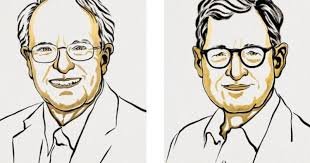

Stockholm:Oct 12,2026: American-born economists Robert E. Hall and Michael Woodford won the Nobel memorial prize in economics on Monday for their work on the microeconomic foundations of macroeconomic stabilisation.
Hall is affiliated with Stanford University in California, and Woodford with Columbia University in New York.
Press Release
This year’s laureates in the economic sciences, Robert E. Hall and Michael Woodford, have developed new macroeconomic models that have significantly improved our ability to implement effective stabilisation policy. On the basis of these models, well-timed fiscal and monetary policy measures can reduce the economy’s peaks and troughs.
The economy is characterised by alternating downturns and upturns. Ever since the economist John Maynard Keynes launched his theories almost a century ago, stabilisation policy has been important for tackling these fluctuations. During recessions, the economy is boosted by reducing interest rates and increasing the budget deficit, while the opposite should be done to slow a booming economy.
However, during the oil crises of the 1970s, it seemed that the Keynesian models that govern when and how measures should be implemented no longer worked. They did not reduce unemployment, but led to uncontrolled inflation instead. The West experienced a decade of low growth, high unemployment and high inflation. Many people believed that stabilisation policy had done more harm than good and that it should be retired.
Robert E. Hall and Michael Woodford are awarded this year’s prize in economic sciences for demonstrating how economic models could be reconstructed to revitalise stabilisation policy. Rather than basing the models on statistical links between macroeconomic variables, such as inflation, production and consumption, they chose to build them on a microeconomic foundation. This encompasses an understanding for how the total mass of individual households and businesses affect the economy through their actions.
A central component in these models is that households and businesses are forward looking when making decisions about savings or product prices. When governments and central banks communicate their plans for economic policy, they can influence this view of the future and move the economy in the right direction. Since the new models’ introduction, they have been extremely helpful in dealing with the economic downturns that have affected us.
“The laureates’ work has provided us with a stable theoretical foundation for the models that are now used by central banks and governments around the world. With them, we are better equipped to deal with shocks in the economy, such as energy crises or sudden changes in how much households consume,” says John Hassler, Chair of the Committee for the Prize in Economic Sciences.
