
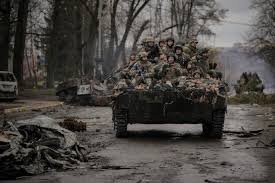

Feb 24,2026:The Russian invasion of Ukraine, launched on February 24, 2022, has now entered its fifth year, emerging as Europe’s deadliest conflict since World War II. Russia launched its full-scale invasion of Ukraine on February 24, 2022. Tens of thousands of civilians and hundreds of thousands of soldiers have been killed in the war as it completes four years of invasion.
Four years of intense clash have inflicted startling human costs: military casualties on both sides approaching or exceeding nearly 1.8 million (killed, wounded, and missing), with hundreds of thousands dead, while over 15,000 civilians have been confirmed killed and millions more displaced.
February 24, 2022: Invasion starts.
On February 21, 2022, Russian President Vladimir Putin recognised the independence of Ukraine’s eastern Donetsk and Lugansk regions, where pro-Russian separatists have been fighting the Ukrainian army since 2014.
Three days later at dawn, Putin announces a major military offensive in Ukraine, which he calls a “special military operation” to “de-Nazify” and “demilitarise” its neighbour.
The Russian army advances rapidly in the south and northeast of the country, but fails to seize the capital Kyiv, from where President Volodymyr Zelensky leads the resistance.
The southeastern port city of Mariupol fell after a brutal months-long siege. The first negotiations, held in Belarus and Turkey, were founded.
– Spring of 2022: Bucha massacre –
After Russian forces abandoned Kyiv’s suburbs, the bodies of hundreds of civilians who had been summarily executed were found on the streets of Bucha and neighbouring areas.
Ukraine accuses the Russian army, which denies responsibility.
The macabre discoveries, witnessed among others by AFP, cause an international outcry and spark the first war crimes investigations.
A year later, on March 17, 2023, the International Criminal Court issued a war crimes arrest warrant against Putin, accusing him of “unlawfully deporting” Ukrainian children from occupied areas of Ukraine to Russia.
Summer 2022-winter 2023: Ukrainian counteroffensives.
From the summer of 2022, Ukrainian forces launched a string of counteroffensives. With deliveries of weapons from its Western allies, Kyiv retakes swathes of the northeastern Kharkiv region and the regional capital, Kherson, in the south. A long and bloody battle takes place in the eastern city of Bakhmut, which lies in ruins.
As it struggles, Russia faces another threat in June 2023: a mutiny by the Wagner mercenary group, which marches on Moscow before retreating.
Its chief, Yevgeny Prigozhin, dies two months later in a mysterious plane crash.
In the summer of 2023, the Ukrainian army relaunches its efforts in the south and east, but fails to pierce Russian defences.
2024: Russia, advances slowly.
From February 2024, Russian forces regain the initiative on the frontline.
Despite losses, Moscow advances slowly but surely, seizing several strongholds in the east from a Ukrainian army short on manpower and ammunition.
In August 2024, Ukrainian troops cross the Russian border, seizing hundreds of square kilometres in the western Kursk region. They are driven out in March 2025, after a battle in which Russia is helped by North Korean troops.
Russia makes a string of deadly drone and missile strikes on Ukrainian territory, which powerful American Patriot air defence missiles and F-16 fighter jets delivered to Kyiv do not counter.
On November 21, 2024, Russia targets Ukraine with a new nuclear-capable intermediate-range ballistic missile, nicknamed Oreshnik, hitting a Ukrainian military factory.
The missile is used for a second time on January 8, 2026, on an aircraft factory.
2025-2026: Trump diplomacy
Back for a second term at the White House, US President Donald Trump creates shock waves by saying he and Putin have agreed to start direct talks.
On February 28, in a televised clash with Zelensky at the White House, Trump threatened to cut military aid to Ukraine.
Trump then blows hot and cold towards both Kyiv and Moscow. In November, he unveils a draft plan for Ukraine which meets Moscow’s main demands, including the ceding of Ukrainian territory, in exchange for security guarantees for Kyiv.
Seeking to keep up the pressure, Russia carries out a series of strikes that knock out large parts of Ukraine’s energy network, leaving hundreds of thousands in the dark and cold during a particularly harsh winter. Ukraine launches strikes on Russian oil refineries in response.
Diplomacy ploughs on. Russian, Ukrainian, and American negotiators meet in Abu Dhabi, then in Geneva in January and February 2026.
Moscow continues to demand Kyiv withdraw completely from the eastern Donbas region, which Ukraine views as a key sticking point.
In Ukraine, millions more have had to flee their homes to escape the fighting as Russia’s troops advanced. Entire cities in Ukraine’s east and south, among them Bakhmut, Toretsk and Vovchansk, have been reduced to rubble by fighting.
Around a fifth of Ukraine is contaminated by mines or unexploded ordnance, according to the U.N.’s Mine Action Service.
The total cost of reconstruction in Ukraine is estimated at around $588 billion over the next decade, the World Bank reported on Monday (February 23, 2026).
Deaths in Russia-Ukraine war
The United Nations has verified over 15,000 civilian deaths in Ukraine since 2022, although it says the actual number is likely considerably higher as it has no access to areas under Russian occupation, like the port city of Mariupol where thousands are reported to have died in a Russian siege. Neither side releases reliable data on military casualties.
Ukrainian President Volodymyr Zelenskyy said earlier this month 55,000 of his soldiers had been killed – a toll widely believed to be an underestimate.
Russia has not given an official update on losses since September 2022.
The Kremlin is pushing for full control of Ukraine’s eastern Donetsk region and a ban on Western military support for Kyiv.
Ukraine says giving in would leave it vulnerable to future attack, is constitutionally impossible, and unacceptable to much of Ukrainian society.
Since Donald Trump returned to the White House, several rounds of talks – in Istanbul, Abu Dhabi and Geneva – have failed to secure a deal.
