
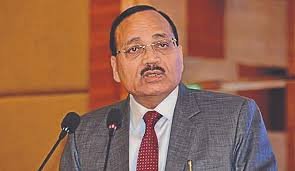

New Delhi, Nov24,2025: Justice Surya Kant today took oath as the 53rd Chief Justice of India at a ceremony held at the Rashtrapati Bhavan. President Droupadi Murmu administered the oath, which was taken in Hindi by Justice Kant.As the CJI, Justice Kant will have a tenure till February 9, 2027. Vice-President CP Radhakrishnan, Prime Minister Narendra Modi, Home Minister Amit Shah, Defence Minister Rajnath Singh, Law Minister Arjun Ram Meghwal and several ministers from his cabinet attended the swearing-in.
Over his tenure in the Supreme Court, Justice Kant has been associated with a series of significant constitutional rulings, including those on the abrogation of Article 370, the revision of Bihar’s electoral rolls and the Pegasus spyware case.
Who is Justice Surya Kant?
Born on February 10, 1962, in Petwar village in the Narnaud region of Hisar, Justice Kant studied at local village schools before earning his degree in law from Maharshi Dayanand University, Rohtak, in 1984. He began his legal practice at the Hisar district court the same year and later shifted to Chandigarh, where he built a thriving practice at the Punjab and Haryana High Court, specialising in constitutional, service and civil law. Three decades later, while serving as a judge, he obtained a master’s degree in law from Kurukshetra University with first-class first.
His rise in the legal profession was swift. At 38, he became the youngest advocate general of Haryana in 2000, was designated a senior advocate the following year, and was elevated as a judge of the Punjab and Haryana High Court in 2004. In October 2018, he took charge as chief justice of the Himachal Pradesh High Court before his elevation to the Supreme Court in May 2019.
Over the past six years in the top court, Justice Kant has authored more than 300 judgments, including in several high-profile constitutional matters. He was part of the Constitution bench that upheld the abrogation of Article 370, the bench that delivered the verdict on Section 6A of the Citizenship Act, and the bench that granted interim bail to former Delhi chief minister Arvind Kejriwal while affirming the legality of his arrest. Most recently, he was also part of the bench that delivered its ruling in the presidential reference on setting timelines for assent to state bills by governors and President.
As executive chairman of the National Legal Services Authority (NALSA), he launched the Veer Parivar Sahayata Yojana 2025 to provide free legal assistance to soldiers, veterans and their families.
New CJI’s top priorities
A day before taking charge, the CJI-designate had spoken to Hindustan Times about his judicial philosophy, his administrative priorities, and the “farmer’s patience and poet’s empathy” that shape his approach to justice.
Acknowledging that he was taking the helm at a time when the Supreme Court faces nearly 90,000 pending cases, Justice Kant identified this as a challenge central to his tenure. “One of my foremost challenges is the arrears in the Supreme Court…My immediate focus is on the optimum utilisation of judicial force, ensuring that the court’s full strength is channelled towards reducing pendency,” he said.
“Many matters can’t be taken up before the high courts and lower courts because related issues are pending here. I will find those matters, ensure benches are constituted, and have them decided. I will also try to see the oldest matters,” said the judge, adding that healthy practices of approaching lower courts first need to be revived.
Justice Kant had also spoken about the human dimension of judging, the institutional discipline he hopes to strengthen, and the immediate priorities he has set for the Supreme Court.
In the interview, Justice Kant reflected on how his formative years on a farm in Petwar village shaped his judicial temperament. “A farmer’s patience taught me that true growth requires time, care and resilience… Justice, like a harvest, cannot be forced; it must be cultivated with diligence and respect for the natural rhythm of due process,” he said.
He added that a “poet’s empathy” allows him to see beyond the facts on paper and understand the human stories behind every dispute. This blend, he said, ensures that his decisions remain both legally sound and humane. The law may supply the framework, he noted, but “the human side of judging is both inevitable and essential.”
Justice Kant described his judicial philosophy as “humanistic,” rooted in the belief that the law must ultimately serve people while maintaining fairness and consistency. Judges, he believes, must primarily function as neutral interpreters, but remain conscious of the broader social context.
As a former chief justice of the Himachal Pradesh High Court and a judge known for strong administrative stewardship, Justice Kant further stressed that a court’s credibility depends on its collective discipline. “Courts are not merely individual judges but collective bodies whose credibility depends on consistency, discipline and efficiency,” he said, adding that reform is a “continuous process” he intends to carry forward.
He emphasised the need to streamline case management, deploy technology to speed up disposals, and ensure punctuality and preparedness across judicial and administrative ranks. “Even small changes, such asprocedural guidelines, infrastructure upgrades, digital adoption, can have a transformative impact,” he said. Empathy and communication, he added, are indispensable to effective leadership.
Apart from pendency, Justice Kant identified mediation as a central plank of his reform agenda. “We must identify a solution, and one of the easiest solutions, which can be a game changer, is mediation,” he said. He noted that the judiciary must encourage government agencies to adopt mediation more readily and relieve pressure on courts.
