
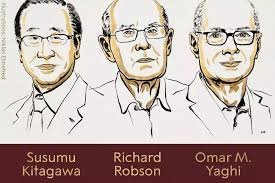

Oct 9,2025: Scientists, spanning continents, win Chemistry Prize for bridging metals and organics.
An Australian, a Japanese and a Jordanian-American scientist were announced winners of the Nobel Prize in Chemistry for discovering and creating a class of materials, called metal-organic frameworks (MOF).
Metallic and organic substances are as far apart in the chemical world as Australia and the United States geographically, and it was inconceivable that stable, useful products could be made out of materials formed by integrating them. But beginning with Richard Robson’s initial conception of them in the mid 70s, sparked from a science project for his Melbourne University students; to Susumu Kitagawa’s dogged determination, in Kyoto University, at creating porous molecules — despite knowing that they were “useless” — but tinkering with them until he created the right kind of structures that were useful enough to work as a filter whilst remaining flexible and pliant; to finally Omar Yaghi at the University of California, Berkley, making a variety of metal-organic frameworks, as he named them, that were — among other things — capable of drawing water vapour out of desert air at night and releasing them as water in the day.
The three will equally shared the prize of 11 million Swedish kroner, about ₹1 crore.
Following the laureates’ groundbreaking discoveries, chemists have since built tens of thousands of different MOFs. Some of these may contribute to solving some of humankind’s greatest challenges, with applications that include separating PFAS (a family of chemicals that are believed to be toxic) from water, breaking down traces of pharmaceuticals in the environment, capturing carbon dioxide or harvesting water from desert air, a press statement noted.
Researchers have developed a molecular kit with a wide range of different pieces that can be used to create new MOFs. These have different shapes and characters, providing incredible potential for the rational — or AI-based — design of MOFs for different purposes.
First of the block and inspired by a project to make wooden block representations of chemical bonds, Mr. Robson began by testing the inherent properties of atoms in a new way. He combined positively charged copper ions with a four-armed molecule; this had a chemical group that was attracted to copper ions at the end of each arm.
When they were combined, they bonded to form a well-ordered, spacious crystal. It was like a diamond filled with innumerable cavities.
Mr. Robson immediately recognised the potential of his molecular construction, but it was unstable and collapsed easily. However, Mr. Kitagawa and Mr. Yaghi provided this building method with a firm foundation; between 1992 and 2003, they made, separately, a series of revolutionary discoveries. Mr. Kitagawa showed that gases can flow in and out of the constructions and predicted that MOFs could be made flexible. Mr. Yaghi created a very stable MOF and showed that it can be modified using rational design, giving it new and desirable properties.
Initially, it was challenging for the broader scientific community to appreciate MOF, as they didn’t seem to be much better than a class of materials called zeolites. But things changed when they succeeded in developing soft MOFs — a step up over zeolites that were hard. One of those who was able to present a flexible material was Kitagawa himself. When his material was filled with water or methane, it changed shape, and when it was emptied, it returned to its original form. The material behaved somewhat like a lung that can breathe gas in and out, changeable but stable.
